National appointments

Public service.

A record of appointments in diplomacy, health administration, national government and agriculture.

Explore the record

At a glance

A record of appointments.

A career spanning Bhutan’s foreign service, national institutions, and ministerial leadership. Concurrent responsibilities are listed separately.

  1. 011975–1986

    Foreign service

    Bhutan’s UN mission in New York and embassy in New Delhi.

  2. 021986–1989

    Ambassador to Kuwait

    Resident Ambassador to Kuwait, accredited to Switzerland.

  3. 031989–1992

    Senior civil service

    Trade, planning, and environmental administration.

  4. 041992–1998

    Health administration

    National Referral Hospital and senior health-services leadership.

  5. 051998–2003

    Health & education

    Minister of Health and Education.

  6. 061999–2000

    Prime Minister

    First term as Chairman of the Council of Ministers.

  7. 072003–2007

    Agriculture

    Minister of Agriculture.

  8. 082005–2006

    Prime Minister

    Second term as Chairman of the Council of Ministers.

Explore the full career timeline

01

Early career

Diplomacy and public administration.

Foreign service · 1975–1986

His early diplomatic appointments included service at Bhutan’s Permanent Mission to the United Nations in New York and as First Secretary at the Royal Bhutanese Embassy in New Delhi.

From 1986 to 1989, he served as Bhutan’s resident Ambassador to Kuwait, with accreditation to Switzerland. Subsequent senior civil-service appointments from 1989 to 1992 spanned trade and industry, power, national planning and environmental administration.

Explore the career timeline
02

Health

Building a health system around access.

Health administration from 1992 · Minister from 1998

The health-sector work described here spans primary care, service standards, safe water and sanitation, financing and international partnerships. These areas were developed through government agencies, health workers, communities and development partners.

The 2018 history of Bhutan’s health services describes Sangay Ngedup’s ministerial tenure, visits to health centres and involvement in the planning of referral-hospital development. WHO also documents his role in establishing the Bhutan Health Trust Fund.
Five connected areas of work

Service delivery, systems and sustainability.

Five connected priorities spanning health-service access, standards, sanitation, financing and international cooperation.

01 / ACCESS

Primary health care closer to communities

Strengthening local services through health workers, outreach clinics (ORCs), Basic Health Units (BHUs), hospitals and health-information systems, alongside the infrastructure needed to deliver care.

Focus: access and continuity of care
02 / SERVICE SYSTEMS

Equity and efficiency in service delivery

Developing health-facility standards, patient-referral arrangements and a balance between primary, secondary and tertiary care, so patients can be treated at an appropriate level of the system.

Focus: standards and coordinated care
03 / PUBLIC HEALTH

Rural water supply and sanitation

Improving hygiene and sanitation through rural water-supply and sanitation programmes, alongside community health services.

Focus: safer water and healthier communities
04 / FINANCING

Public investment and sustainable financing

Advocating for health-sector resources while developing a dedicated financing mechanism for vaccines and essential medicines: the Bhutan Health Trust Fund (BHTF).

Focus: predictable funding for essential supplies
05 / PARTNERSHIPS

Bilateral and multilateral cooperation

Working with bilateral and multilateral partners to support health infrastructure, service development and the training of health personnel, including cooperation with Denmark, Norway, Germany, India, Japan, Thailand, Myanmar and Sri Lanka.

Focus: infrastructure, training and technical cooperation

Three stories in focus

From plans to institutions.

Selected initiatives in primary care, referral hospitals and health financing.

01

Local service delivery

BHUs, outreach clinics and health workers

The historical record describes how Bhutan’s network of BHUs and outreach clinics developed over time to serve communities beyond district centres. The health-sector priorities above include strengthening that network through facilities, staffing, service standards and referral systems.

What this illustrates: the importance of connecting buildings, trained people and clear referral arrangements—not infrastructure alone.

02

Referral care

Hospital planning in Thimphu and Mongar

Planning for modern referral-hospital developments in Thimphu (JDWNRH) and Mongar (MRRH) began during his health-sector tenure, with subsequent construction and operation carried forward by the wider health system.

Later development: the Eastern Regional Referral Hospital records construction of its present Mongar hospital beginning in 2005 and its inauguration in 2008. The book records completion of the new 350-bed national referral hospital building in 2009.

Mongar hospital history
03

Health financing

The Bhutan Health Trust Fund

WHO records his role in establishing BHTF to support financing for vaccines and essential medicines. The Fund’s own history dates its launch to 12 May 1998; its mandate explains how dedicated financing supports continuity in primary health care.

Continuing institutional work: the Fund, government and partners have developed its financing and operations over subsequent years. Those later outcomes are part of a wider institutional history.

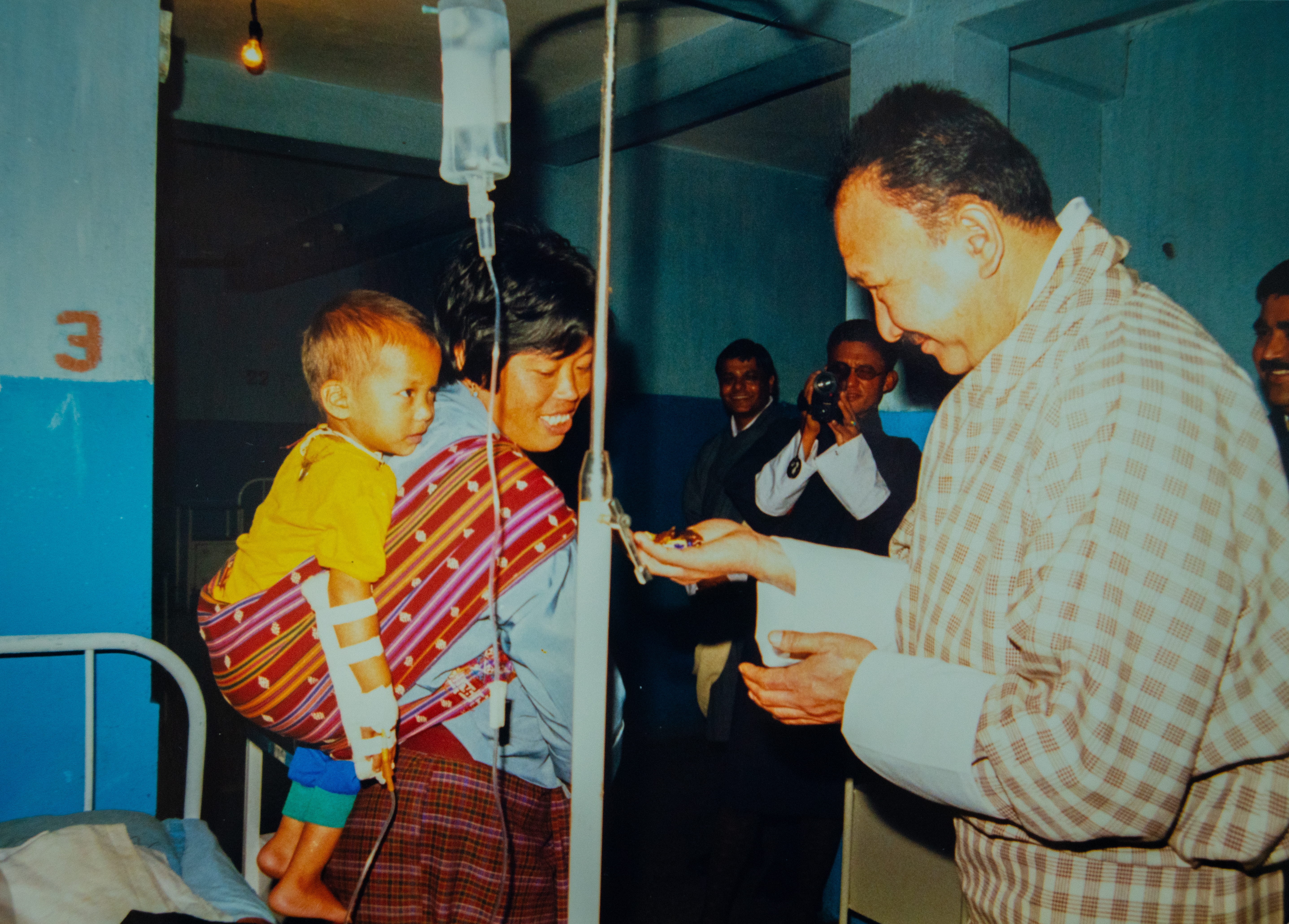
Archival image from a hospital visit
From the health-services photo archive.
03

Education

Opening doors to learning.

Minister of Health and Education · 1998–2003

His work in education extended beyond the classroom: from expanding access to schools and supporting teachers, to helping young people find direction through career guidance, scouting and values-based learning.

These priorities brought together the practical foundations of education—schools and trained teachers—with the wider development of students as individuals and members of their communities.

01 / ACCESS

Making education more accessible

Supporting the expansion of school infrastructure and access to education, with attention to children and communities beyond established education centres.

02 / TEACHERS

Continuing education for teachers

Supporting opportunities for teachers to continue learning, develop their skills and strengthen the quality of teaching in schools.

03 / STUDENT DEVELOPMENT

Guidance, scouting and values

Supporting career counselling, the scouting movement and values-based education as part of students' personal and social development.

04 / WHOLESOME EDUCATION

Learning beyond examinations

Promoting a broader approach to education that recognises character, wellbeing, creativity, physical activity and life skills alongside academic learning.

05 / HIGHER EDUCATION

The Royal University of Bhutan

He was involved in the University's establishment and served as interim Vice-Chancellor during its early formation. The University brought together tertiary education institutions within a national university framework.

Documentary tributes

A career remembered.

Two documentary tributes reflecting on Lyonpo Sangay Ngedup's contributions to health and education, produced following his ministerial service.

01 / Health21 minutes

A tribute to his service in health

Ministry of Health

A retrospective on his work in Bhutan's health sector, including the development of health services, public health initiatives and the communities reached through that work.

02 / Education12 minutes

A tribute to his service in education

Education tribute documentary

A retrospective on his education-sector work, including access to education, teacher development, student guidance and wholesome education.

04

National government

Two terms as Prime Minister.

Sangay Ngedup served two terms as Prime Minister and Chairman of the Council of Ministers. His responsibilities as Minister of Health and Education and, later, Minister of Agriculture overlapped with these terms.

First term1999–2000

Chairman of the Council of Ministers · Concurrently Minister of Health and Education.

Second term2005–2006

Chairman of the Council of Ministers · Concurrently Minister of Agriculture.

05

Government reform

Good Governance & Good Governance Plus.

During his two terms as Chairman of the Council of Ministers, government-wide reform exercises examined public administration, institutional responsibilities and the delivery of public services in pursuit of Gross National Happiness.

1999

Good Governance

Enhancing Good Governance for Gross National Happiness

During his first term, the government undertook a reform exercise centred on efficiency, transparency and accountability. The report examined administrative structures, responsibilities and public-service practices. Lyonpo contributed the foreword as Chairman of the Council of Ministers.

Among the institutional developments associated with the 1999 task force was a recommendation to establish an Office of Legal Affairs, subsequently established as the government’s central legal agency.

2005

Good Governance Plus

In Pursuit of Gross National Happiness

Good Governance Plus formed part of the reform agenda during his second term. The 2005 exercise addressed responsive public administration, professionalism, decentralised governance and more effective delivery of government services.

The Royal Civil Service Commission records the transition from the cadre system to the Position Classification System in 2005–2006. Later government assessments also discuss the 2005 report’s emphasis on transparency, accountability and decentralised governance.

Explore reports & publications
05

Agriculture

Rural livelihoods, land and food systems.

Minister of Agriculture · 2003–2007

As Minister of Agriculture, his portfolio covered rural livelihoods, land management and food systems. Selected policy documents and government reports record initiatives from this period.

2005

National Land Management Campaign

Bhutan’s 2006 report to the UN Convention to Combat Desertification records that he launched the campaign in July 2005 in response to land-degradation concerns.

View Bhutan’s report (section 5.1)
2006

National Framework for Organic Farming

The Ministry of Agriculture’s framework set out approaches for developing organic farming in Bhutan. Its foreword is signed by Sangay Ngedup as Minister of Agriculture.

Read the framework and foreword
2007

Food Rules and Regulations

A Ministry of Agriculture notification dated 16 July 2007, signed by Sangay Ngedup, issued the Food Rules and Regulations of Bhutan 2007.

View the signed notification

· Related publications

Continue exploring

The wider career record.

Explore the career timeline, international health work and the 2002 Move for Health Walk.